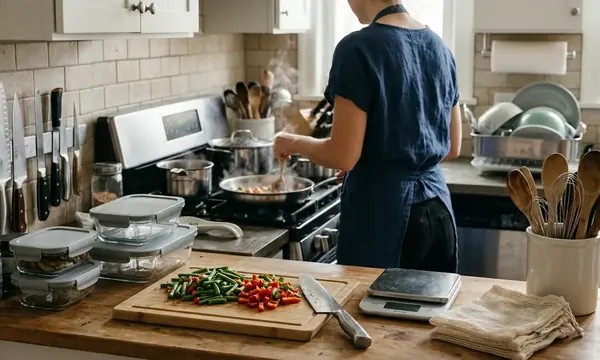
I used to treat gut health like a scavenger hunt for one miracle ingredient. What finally stuck was simpler: feed the community already living with you, using foods that already belong in an ordinary kitchen.
What's Inside
- Key Takeaways
- How We Learned to Feed the Gut
- Fiber-Rich Everyday Foods Your Microbes Thrive On
- Fermented Foods Worth a Place on Your Table
- Polyphenol-Packed Picks Beyond the Usual Suspects
- Build Variety Without Overwhelm
- Ease In So Your Digestion Stays Comfortable
- A Longer View of Your Plate
Key Takeaways
- Fiber, fermented foods, and polyphenols are the three everyday pillars that feed beneficial gut microbes through nutrition you can actually cook with.
- Variety matters more than any single superfood—rotate plants, ferments, and colors across the week for mindful sourcing that stays realistic.
- Start small with new high-fiber or fermented items to reduce bloating and build tolerance before you scale portions.
A practical first-day combination looks like 40–50 grams of dry oats at breakfast, 1 tablespoon of refrigerated sauerkraut at lunch, and 75–100 grams of berries after dinner. Keep each new addition steady for 3–7 days before increasing the portion or adding another unfamiliar high-fiber food.
How We Learned to Feed the Gut
Long before anyone poured samples onto culture plates, traditional kitchens preserved cabbage, milk, soy, and grains with living microbes. Fermentation was a storage method first. The wellness story came later.
In the early twentieth century, attention turned toward fermented dairy and digestive resilience. A widely discussed 1907 hypothesis linked fermented milk consumption with intestinal microbial activity. It preceded modern clinical trial methods, so I treat it as an early scientific proposal rather than proof—and that gap is part of why kitchen practice stayed ahead of the lab for so long.
From roughly 2005–2015, culture-independent sequencing widened the view from a handful of readily cultured organisms to thousands of microbial lineages and their genes across human cohorts. The gut stopped looking like a simple tube and started looking like a dense ecosystem shaped by daily meals. Modern diet studies commonly observe food-related microbial changes over days to weeks, while longer community patterns still track habits held over months and years.
That arc matters for seasonal eating. You do not need a lab coat to join it. You need repeated plates.
Fiber-Rich Everyday Foods Your Microbes Thrive On
Soluble and insoluble fibers act as fuel—prebiotics, for beneficial species. Approachable sources already sit in most pantries: oats, barley, beans, lentils, chickpeas, apples, pears, bananas, onions, garlic, leeks, and cooled potatoes or rice.
Resistant starch is the quiet player. When you cook potatoes or rice, some starch is easy to digest. Cool those starches and a portion reorganizes into a form your own enzymes handle less well, so more of it reaches the microbes. Cook potatoes or rice, move them into shallow containers within 2 hours, refrigerate at 4°C or colder for 12–24 hours, then eat cold or reheat thoroughly.
Serving ideas that fit real kitchen rituals
- Overnight oats: combine 40–50 grams of rolled oats with 120–180 milliliters of milk or kefir and refrigerate 6–12 hours.
- Lentil soups and bean salads built around a modest base portion.
- Hummus with raw vegetables.
- Banana-oat smoothies when chewing a full bowl feels like too much.
Begin with 2–4 tablespoons of cooked beans or lentils per meal, then increase over 7–14 days if you feel comfortable. A typical full serving lands around 1/2 cup cooked. Opened canned beans can be rinsed, moved to a covered container, refrigerated, and used within 3–4 days.
Fiber Pace Note
People with diagnosed gastrointestinal conditions—including IBS, inflammatory bowel disease, gastroparesis, or a prescribed low-fiber or low-FODMAP plan, should coordinate substantial fiber changes with their clinician or dietitian. Several of these foods can aggravate symptoms depending on the person.
Fermented Foods Worth a Place on Your Table
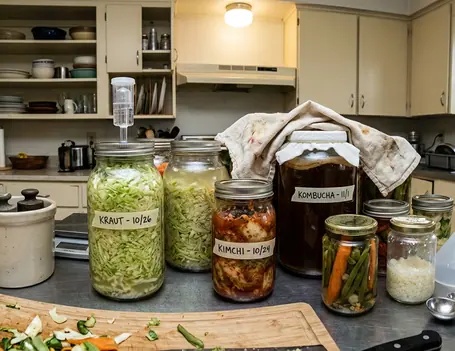
I compare live-culture options the way I compare produce: by what they still carry when they reach the table. Widely available choices include plain yogurt, kefir, sauerkraut, kimchi, miso, tempeh, and traditionally fermented pickles. Vinegar-only shelf pickles are a different product.
A shelf-stable vinegar pickle can provide flavor and vegetables but may contain no living cultures; sour taste alone is not evidence of fermentation or probiotic activity. Check refrigerated labels for wording such as “contains live cultures” and for named cultures in the ingredient list. A statement such as “heat-treated after culturing” signals that viable cultures are not expected. Shelf-stable yogurt or fermented vegetables can still be food, yet they should not count as a live-culture choice unless packaging explicitly confirms viable cultures through the end of shelf life.
Label Reality Check
Start with 1–2 tablespoons of sauerkraut or kimchi, 60–120 milliliters of kefir, or 75–100 grams of yogurt on 2–3 days during the first week. Small portions teach your digestion what it can welcome.
How I put ferments on the plate
- Yogurt with fruit and seeds.
- Kefir smoothies when mornings run short.
- Sauerkraut on grain bowls.
- Miso stirred into warm broth after the pot leaves a full boil—protects flavor and may preserve more viable organisms when the product was unpasteurized.
- Kimchi with eggs or rice.
Field work on fermented-food patterns lines up with a 2021 controlled feeding study in 36 adults that used a 10-week dietary phase: 4 weeks of gradual increase, then 6 weeks at the assigned intake. The fermented-food group showed increased microbiota diversity, while the high-fiber group showed greater microbial carbohydrate-processing capacity without a uniform rise in diversity. Both levers matter; they do different jobs.
Polyphenol-Packed Picks Beyond the Usual Suspects
Polyphenols are plant compounds that gut microbes transform. In turn, those interactions support a more diverse community. Everyday sources span berries, grapes, apples, colorful vegetables, extra-virgin olive oil, green tea, cocoa or dark chocolate, plus herbs and spices such as oregano, rosemary, and turmeric.
Use 75–150 grams of fresh or frozen berries in yogurt, oats, or a smoothie. Unsweetened frozen fruit remains useful outside local harvest season, which keeps seasonal eating honest in winter. Steep green tea for 2–3 minutes for a milder cup or 3–5 minutes for a stronger extraction, adjusting for bitterness rather than treating longer brewing as automatically better.
A food-sized chocolate portion is about 10–15 grams. Choose a cocoa-rich product and treat it as one source among many. Rotate at least three color groups over 7 days—for example, purple berries, red tomatoes, and dark-green herbs, while using extra-virgin olive oil as a dressing or finishing fat.
Easy polyphenol pairings
- Berry-yogurt parfaits.
- Olive-oil dressed salads.
- Afternoon green tea.
- A square of dark chocolate after dinner.
- Herb-heavy roasted vegetables.
Build Variety Without Overwhelm
The problem is rarely knowledge. It is the full-pantry overhaul that collapses by Wednesday. The solution I return to is a three-decision week: one new plant food, one ferment, and one polyphenol-rich add-on.
For one 7-day cycle, choose one plant such as barley, one ferment such as plain yogurt, and one polyphenol addition such as frozen blueberries. Use each on 2–3 occasions before changing the set. That rhythm builds variety without turning nutrition into a second job.
Batch moves that lower friction
- Cook a batch of beans sufficient for 3–4 days, refrigerate in shallow covered containers within 2 hours, and freeze portions you will not eat in that window.
- Place the selected ferment at eye level in the refrigerator.
- Pre-portion yogurt into 150–200 gram containers.
- Lean on rinsed canned beans and frozen berries when preparation needs to shrink to roughly 2–5 minutes.
Mix textures and temperatures so meals stay appealing—warm miso soup beside a cool kefir smoothie on different days. Shelf-stable yogurt still counts as dairy or a convenient snack; only label-confirmed live cultures make it a live-culture selection.
Weeknight Trio Win
One unfamiliar plant, one live-culture food, one colorful or herb-rich finish. Three decisions. Repeat until they feel ordinary.
Ease In So Your Digestion Stays Comfortable
Gas and bloating show up often when fiber or ferments jump overnight. Framed gently, those responses are frequently temporary when increases stay gradual. The same onion, bean, kefir, or kimchi portion may feel fine for one person and provoke gas, reflux, or IBS symptoms in another because baseline diet, microbial community, medication use, salt sensitivity, and gastrointestinal conditions differ.
Practical pacing
Add one high-fiber food at a time. Drink water with meals. Chew thoroughly. Space large bean portions. Same-day starter: add 2 tablespoons of cooked lentils to one meal, drink a glass of water with that meal, chew slowly, and wait 3–4 days before doubling the lentil portion.
Cooking tactics that help
- Soak dried beans for 8–12 hours, discard the soaking water, rinse, and cook in fresh water until fully tender.
- Drain and rinse canned beans for 20–30 seconds.
- If cruciferous vegetables feel difficult, begin with 1/4–1/2 cup cooked until tender rather than a large raw serving.
- Peel fruit temporarily if skins bother you at first.
Seek medical care promptly for severe or persistent abdominal pain, blood or black stool, repeated vomiting, fever, dehydration, unintentional weight loss, or a major stool-pattern change lasting more than 7–14 days.
A Longer View of Your Plate
Everyday meals continue an ancient partnership between humans and microbes. Traditional kitchens kept that partnership alive through preservation; sequencing tools later explained why the partnership responds so quickly to what lands on the plate. For a broader scientific frame, the NIH overview of the human microbiome sketches how researchers mapped that living community.
Prepare tomorrow’s trio tonight: 40–50 grams of oats, 75–100 grams of live-culture yogurt, and 75–100 grams of berries. Repeat for 3–7 days, then rotate one component—barley for oats, or an apple for berries, rather than rebuilding the whole meal.
Large microbiome gene catalogs assembled from many people contain millions of nonredundant microbial genes, compared with roughly 20,000 human protein-coding genes.